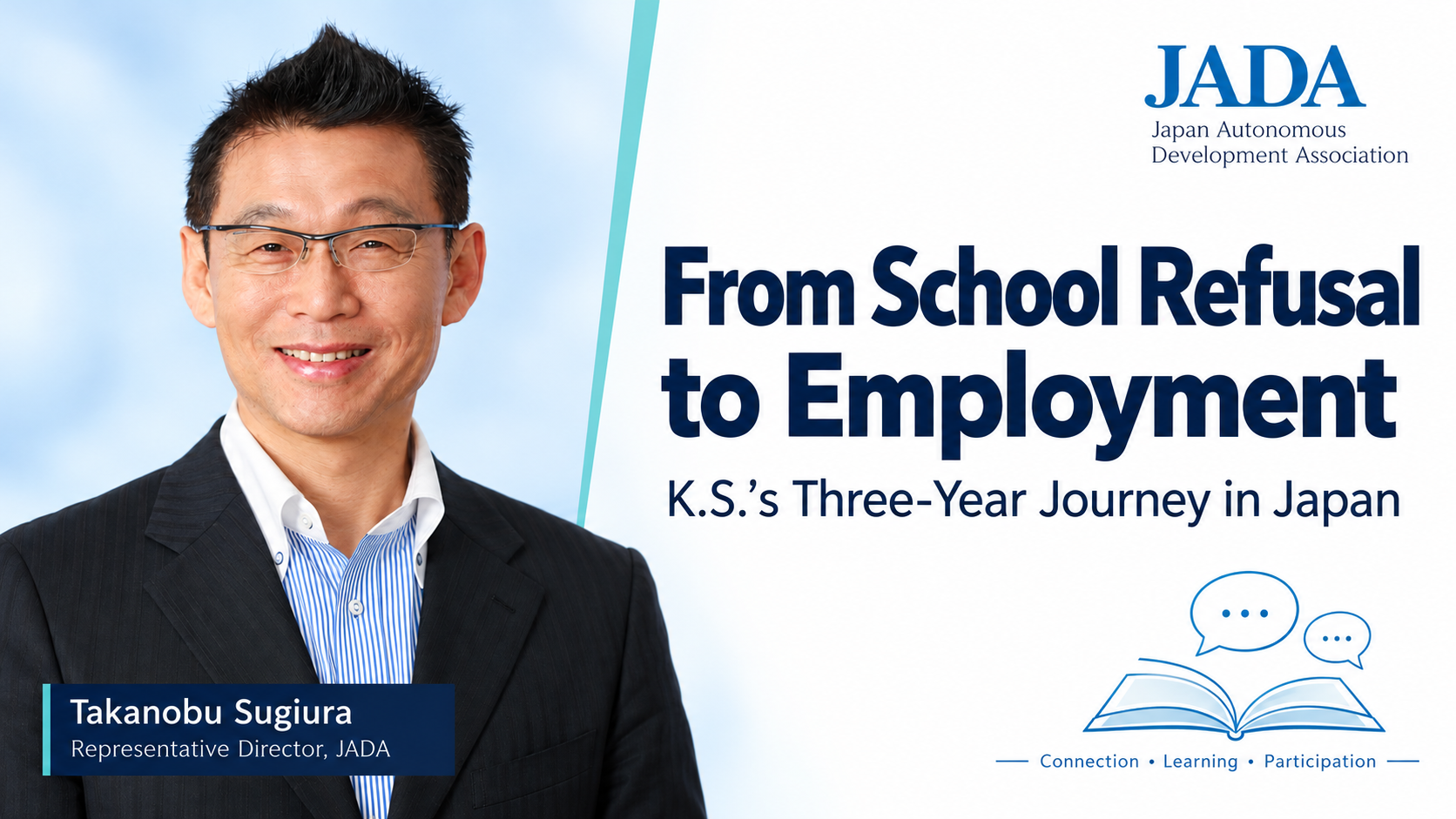
What can a path from school refusal to employment look like? For K.S., a young person in Japan who experienced bullying in junior high school, the journey included three years of attending Kousotsu Shienkai, shared activities, graduation, and employment at LEC Tokyo Legal Mind.
His story shows a practical question for families and educators: how can support create opportunities to reconnect with people, learning, and life beyond school?
When bullying interrupted school life
K.S. experienced bullying during junior high school and found it difficult to attend. His prolonged absence was connected to painful experiences with other people. Understanding that starting point matters when considering opportunities to participate again.
He subsequently attended Kousotsu Shienkai, a Japanese nonprofit providing direct educational and practical support to young people. Over three years, his experiences included ski trips, camping, overseas study, events, and activities with peers.
A difficult experience was part of the journey
During his first ski trip, a staff member took K.S. onto an advanced slope. He became tearful and said he would never come back. That distress is part of the record and should not be overlooked.
He nevertheless enjoyed the trip as a whole with his peers. He returned the following year and continued participating in the annual ski trips until graduation.
This episode is not a recommendation to force participation or place a young person in an activity beyond their ability. Activities should be planned around the person’s wishes, readiness, and safety. In this case, both the difficult moment and the later return belong in the account.
Three years of direct support and social experience
Kousotsu Shienkai provided the setting for K.S.’s ongoing attendance and activities. Such experiences can offer opportunities to share daily routines, spend time with peers, take on roles, and talk about personal experiences. They should be considered within an individual support plan rather than offered as a guaranteed route to employment.
K.S. also appeared in a video describing his own school refusal experience and restart. His account provides a personal perspective alongside the later update on graduation and employment.
Watch K.S. describe his experience
Japanese-language content. This is testimony from K.S. himself. An English rendering of the video title is “A junior high school student restarts after bullying-related school refusal: insights from K.S. on continuing education.”
Original Japanese title: いじめで不登校になった中学生が再出発!K.S君から学ぶ進学のヒント
Publication date: September 5, 2025, according to JADA’s shared case record.
Publishing channel: JADA’s official Japanese-language channel. The full channel name recorded in the source is “JADA 一般社団法人未来自律支援機構【公式】不登校・引きこもり解決率90% 杉浦孝宣”. The percentage is part of that recorded channel name, not an effectiveness claim made by this article.
Watch the original video on YouTube (Japanese)
Graduation and employment: a later update
According to JADA’s October 18, 2026 case record, K.S. graduated from high school in March 2026 and subsequently entered employment at LEC Tokyo Legal Mind. This is a later update, separate from the video published in September 2025.
The record confirms employment but does not specify his employment contract type. It also does not establish long-term job retention or the completion of every aspect of social autonomy.
Connecting the case to JADA’s support framework
JADA’s support philosophy brings together Parent Coaching × Direct Support for the Young Person. JADA focuses on understanding the young person’s and family’s situation, parent coaching, and comprehensive support planning. Kousotsu Shienkai provides direct support through activities such as attendance, learning, outreach, and pathway support. The documented activities in K.S.’s case were provided through Kousotsu Shienkai; the shared record does not detail individual parent-coaching sessions for his family.
Viewed retrospectively through today’s 7 Steps to Autonomy, his experiences connect learning, social relationships, and participation in work. This does not mean the current framework’s names were used at the time or that everyone should follow the same sequence.
Within Autonomy Stage OS, the 5-Stage Assessment helps organize understanding of the young person and family. It is a support framework, not a medical diagnosis. Social Autonomy remains the longer-term goal: developing the capacity to make choices, act, and contribute through learning, work, and community life.
Questions from parents and educators
Does a young person need to be ready for employment before joining activities?
No. Support can begin with an appropriate opportunity for connection. K.S.’s record includes three years of attendance and varied experiences before graduation and employment. A practical first step is to ask which person, place, or activity the young person currently feels comfortable considering.
Should parents insist on a camp or overseas study?
JADA does not recommend compulsory participation as a general approach. K.S.’s ski-trip experience included genuine distress as well as later enjoyment and return visits. Discuss preferences and concerns, and ask support staff what adjustments or smaller alternatives are available.
Does this case prove that the approach will produce the same result for others?
No. It is an individual practice-based case, not a controlled study or a guarantee. The useful task is to examine the starting situation, actual support, setbacks, and documented outcome when considering another person’s needs.
What parents can do next
- With respect for privacy, note the current pattern of sleep, meals, outings, and contact with people outside the family over seven days.
- Ask about one activity or relationship the young person would feel comfortable exploring. Listen without turning the conversation into a demand.
- Discuss with other caregivers how to respond consistently and leave room for the young person’s choices.
- When contacting a support organization, ask who will work directly with the young person, what support parents can receive, and how plans are reviewed.
Further reading and international exchange
Explore the JADA Success Hub / Evidence (English) and the Japanese case record for K.S. (CASE22). These accounts document individual pathways; they do not promise identical outcomes.
For research exchange, professional dialogue, or media inquiries about JADA’s practice-based approach, visit the JADA English website and use its contact link.