
AUTONOMY STAGE OS
A framework for understanding the current situation.
Autonomy Stage OS is JADA’s framework for understanding the current situation of young people and families facing school refusal and social withdrawal (hikikomori).
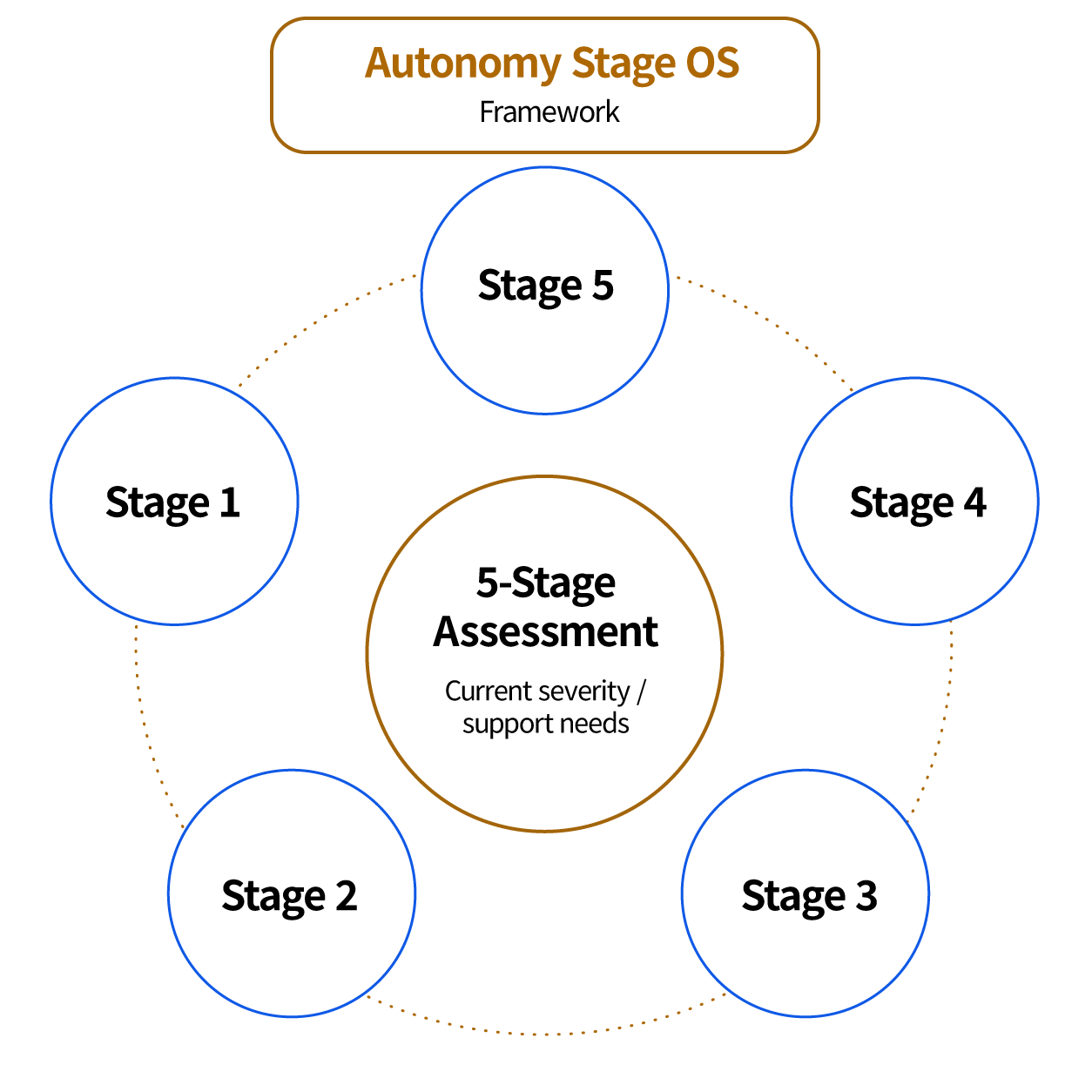
Within it, the 5-Stage Assessment is used to identify current severity and determine the level of support needed.
01 Overview
What is Autonomy Stage OS?
Autonomy Stage OS provides a structured way to understand the current situation of young people and families facing school refusal and social withdrawal (hikikomori), and to organize support according to their needs. The 5-Stage Assessment is used within the framework to identify current severity and the level of support needed.
-
Practice-informed
Built on decades of real-world practice and accumulated knowledge.
-
Person-centered
Support begins with each person’s current situation, needs, and circumstances.
-
Stage-appropriate
Support is planned according to the severity and support needs identified through assessment.
-
Future-oriented
Support is designed with Social Autonomy as the long-term goal.
02 5-Stage Assessment
Current severity and support needs
The 5-Stage Assessment is an assessment framework within Autonomy Stage OS used to identify the current severity of school refusal and social withdrawal (hikikomori), understand the current situation of the young person and family, and determine the level of support needed.
-
Stage 1
-
Stage 2
-
Stage 3
-
Stage 4
-
Stage 5
The 5-Stage Assessment is not a medical or psychiatric diagnosis.
03 5-Stage Assessment
How assessment informs support
The 5-Stage Assessment helps organize information about the young person’s current situation and support needs. The assessment can then inform support planning and ongoing review.
5-Stage Assessmentwithin Autonomy Stage OS
- Observation & ConversationUnderstand the person and family’s situation
- AssessmentEvaluate across domains and indicators
- Stage IdentificationIdentify the current stage (1–5)
- Support PlanningDesign stage-appropriate support and goals
- Ongoing ReviewReview and update regularly
Assessment is not a label. It is a tool for understanding the current situation and informing appropriate support.
04 Relationship
How Autonomy Stage OS connects with our approach
Autonomy Stage OS works together with JADA Support Philosophy and 7 Steps to Autonomy to create a consistent support system.
- Autonomy Stage OS Framework for understanding the current situation and support needs. 5-Stage AssessmentAssessment framework for identifying current severity and support needs.
- JADA Support Philosophy Parent Coaching × Direct Support for the Young Person
- 7 Steps to Autonomy JADA’s practical support process based on the person’s current situation and support needs.
- JADA Success Hub / Evidence Real-world outcomes, accumulated knowledge, publications, media, and practice-informed insights.
05 Who it is for
For professionals, organizations, and communities.
Autonomy Stage OS provides a shared framework for understanding current situations and support needs across professional, educational, family, and community settings.
Support Professionals
Social workers, counselors, educators, caseworkers
Schools & Educators
Teachers, school counselors, special needs coordinators
Families & Caregivers
Parents, guardians, and family members
Organizations & NGOs
Nonprofits, community groups, and support organizations
Policy Makers & Researchers
Government, researchers, universities, and policy institutions