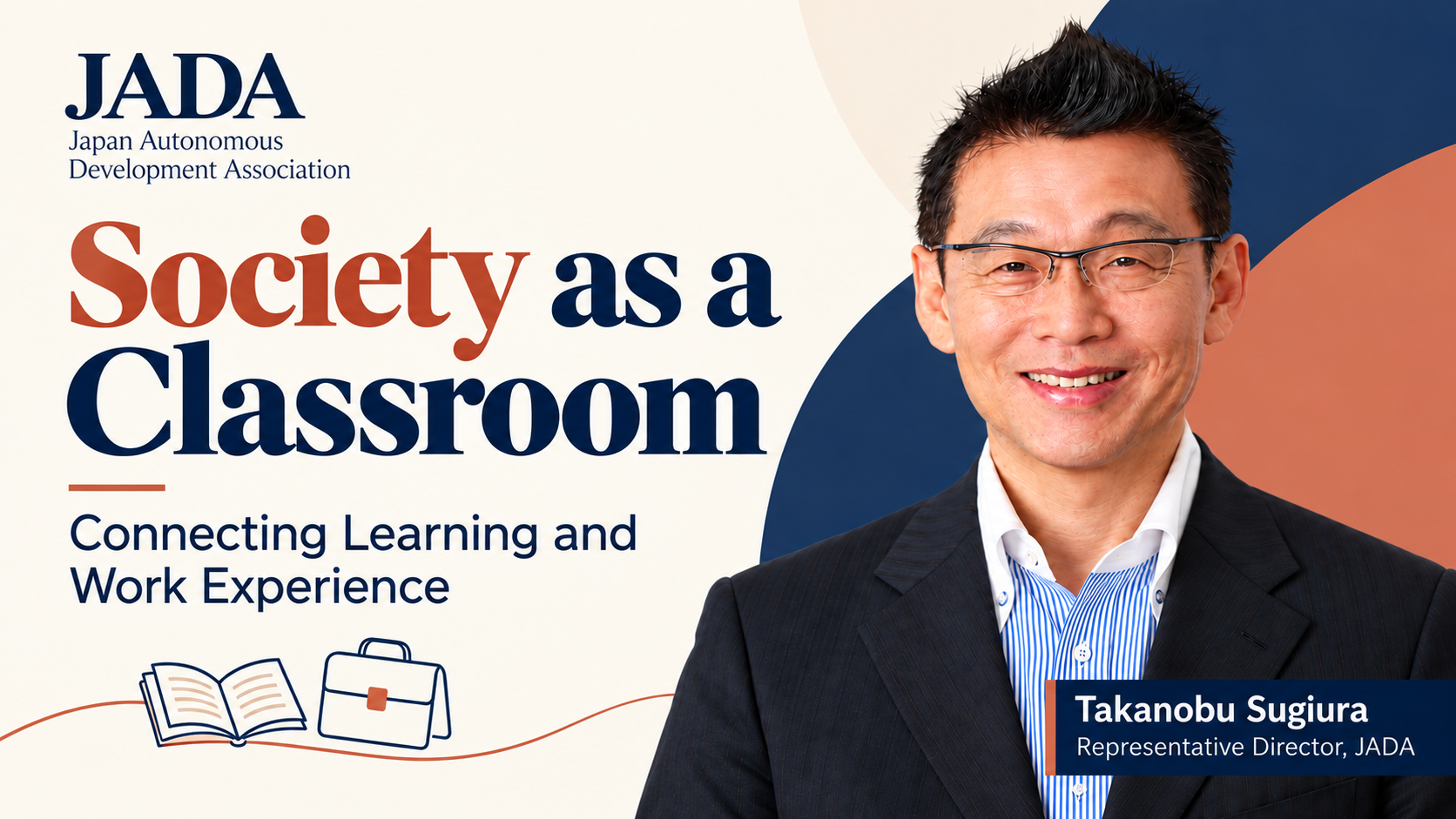
Learning and work experience are often discussed as separate destinations. A historical practice associated with Yoronotaki and Kousotsu Shienkai asks a different question: how can educational opportunities and experience in society support one another?
The idea was to make society itself a classroom. That means paying attention to roles, relationships, preparation, and the young person’s own participation, rather than treating work as an automatic solution to leaving school.
A historical partnership, not a current recruitment notice
JADA’s shared account describes learning during the day alongside part-time work or work experience later in the day. It also records Takanobu Sugiura introducing a young person directly to Yoronotaki’s president for an interview.
This is a historical practice account. It does not confirm that the same classroom arrangement, hours, jobs, or application route are available today. Current opportunities and conditions must be checked with the organizations concerned.
The young people who worked at Yoronotaki should not be confused with Sakou’s company pathway or S’s employment at JA. Similar themes do not make separate people into one case.
What can make a workplace an educational setting?
An educational purpose needs to be explicit. A participant might be learning how to prepare for an agreed time, ask for clarification, understand a role, or reflect on a new experience. These are possible planning questions, not claims that every workplace necessarily provides such learning.
A useful arrangement explains who supervises, what the tasks involve, what help is available, and how concerns are raised. Employment conditions and educational support also need to be understood in their own terms rather than blended into a vague promise of experience.
Coordinate the demands of learning and work
A timetable can look manageable on paper while containing unfamiliar travel, social contact, instructions, and physical demands. Ask how the person experiences the whole day, not just whether a shift or lesson was completed.
Participation should not require a young person to hide difficulty in order to preserve an opportunity. Agree on how to review workload, communication, and the person’s wishes. An adjustment or a different route may be more appropriate than simply increasing expectations.
Keep the roles of partners distinct
An employer, an education provider, a support practitioner, and a parent have different responsibilities. A partnership becomes clearer when the young person knows whom to ask about each issue.
JADA provides consultation, parent coaching, assessment, and comprehensive planning. Kousotsu Shienkai provides direct educational and practical support. A company may offer a setting or an opportunity, but that should not be described as evidence that every participant achieves Social Autonomy.
A retrospective connection to the 7 Steps
Viewed through today’s 7 Steps to Autonomy, the historical Yoronotaki practice connects with STEP 6, pathway and social participation support. That interpretation does not mean the current framework name was used at the time.
STEP 6 is not limited to one employer. Nor does entering a job automatically establish STEP 7, Social Autonomy. Continued participation, choice, relationships, and contribution need their own evidence over time.
The 5-Stage Assessment within Autonomy Stage OS serves a different purpose: organizing understanding of the current situation and support needs. It is not a medical diagnosis or a workplace selection test.
Related video from JADA Global
In this Japanese-language conversation, Sugiura and Kousotsu Shienkai’s chair discuss searching for part-time work, preparing applications, and reviewing interview preparation after rejections. The Japanese automatic transcript includes checking a résumé, clothing, and communication, as well as peers acknowledging a student’s eventual success.
This conversation is a separate source from the historical Yoronotaki account above. It illustrates practical work around an application, rather than evidence of a current partnership vacancy or a guaranteed route to employment. Families can ask who will help with preparation and how the experience will be reviewed if an application is unsuccessful.
Video: School refusal: Supporting Part-Time Work and Social Connection | JADA
Channel: JADA Global. Published on YouTube: 2026-10-20. Japanese-language content. The title and description are in English; English audio and subtitles have not been verified.
Questions for families and partner organizations
Is this article offering a job at Yoronotaki?
No. It discusses a historical practice and the questions it raises. Current openings, eligibility, and support arrangements have not been verified here.
Does work experience replace education?
Not automatically. Learning goals, qualifications where relevant, work conditions, and the young person’s preferences need to be considered together. A meaningful role does not erase other needs.
Is hiring itself evidence of complete autonomy?
No. An offer, starting work, and sustaining participation are distinct milestones. A partnership record should report each accurately.
A practical review checklist
- Ask the young person what they want to learn or explore through the opportunity.
- Clarify tasks, conditions, supervision, and how to raise concerns.
- Consider the demands of education, travel, and work together.
- Agree on responsibilities and a review point before assuming that the arrangement is settled.
Read the historical Yoronotaki article (Japanese) and JADA Support Philosophy. For professional dialogue about partnerships linking learning and social participation, contact JADA.