
EVIDENCE
The 90%+ Resolution Record
External Review, 40+ Years of Practice, and Documented Outcomes
- Long-term practice40+ years in the field
- Public disclosureOutcomes measured
- External reviewItabashi Award, 2010
- NPO activityHigh School Support Assoc.
- Press conferenceNHK, national press
- PublicationTakarajimasha
- Media coverageNHK and others
- Certified NPOPublic accountability
- SystematizationAutonomy Stage OS
- Social AutonomyThe final goal
- 40+ yearsDirect practice
- 10,000+Young people and families
- 90%+Resolution record
JADA — the Japan Autonomous Development Association — reports a resolution record of more than 90% based on over 40 years of direct practice supporting more than 10,000 young people and families affected by school refusal, high school dropout, prolonged social withdrawal and hikikomori.
The 90%+ figure is not presented as a short-term marketing statistic.
It reflects a long history of direct support, documented educational and social outcomes, public disclosure of results, external review, nonprofit development, publication, national media coverage, and the later systematization of accumulated practice through JADA.
The record is traced here in four chapters.
CHAPTER 1
The Gakuryokukai Period
From school refusal and dropout to transfer into Tokyo metropolitan high schools. Outcomes were measured and externally reviewed.
 Enlarge
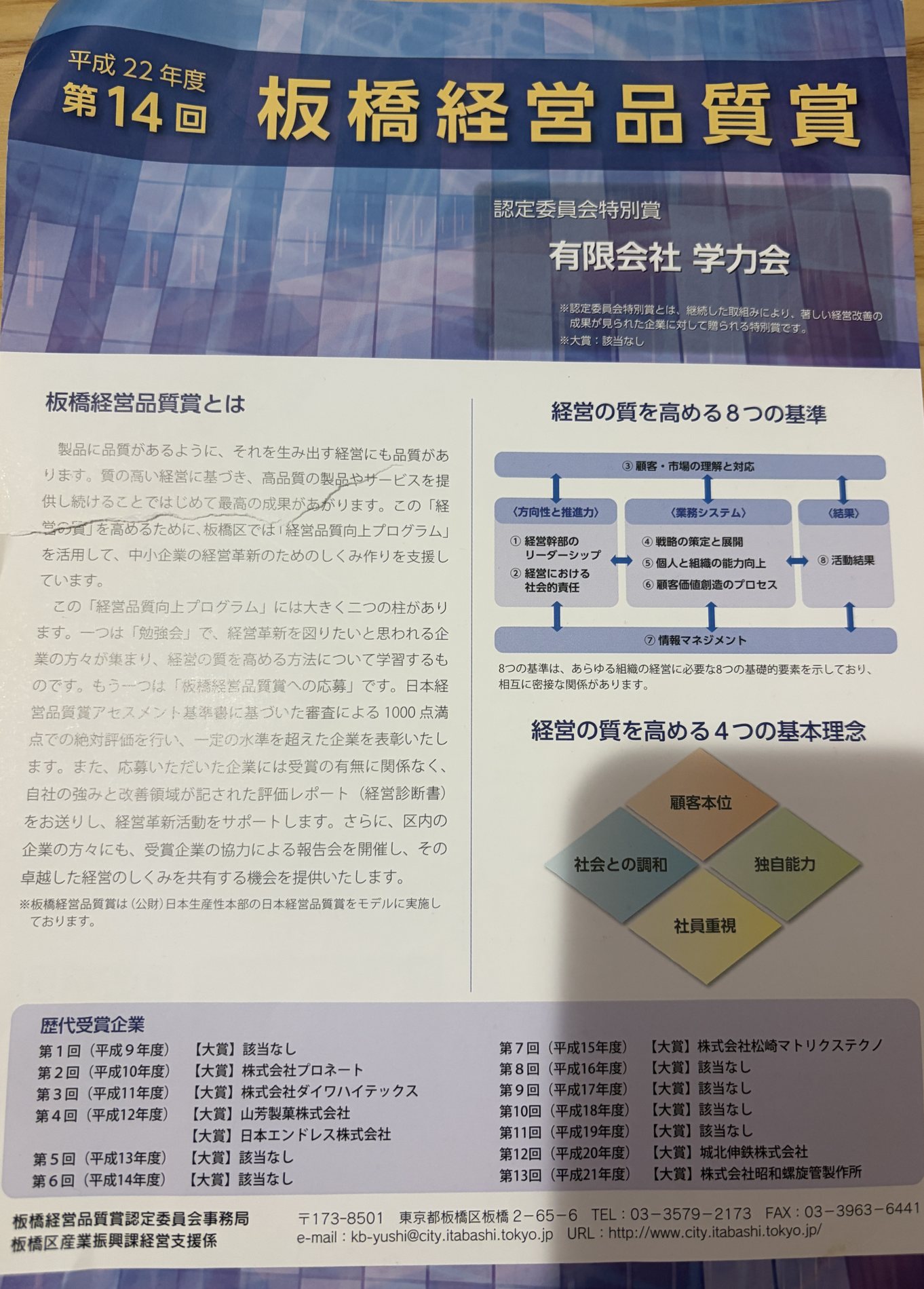
- “Special Award — Gakuryokukai Co., Ltd.”
- “Grand Award: not given”
- Eight criteria for management quality
- Past recipients (1st–13th awards)
 Enlarge
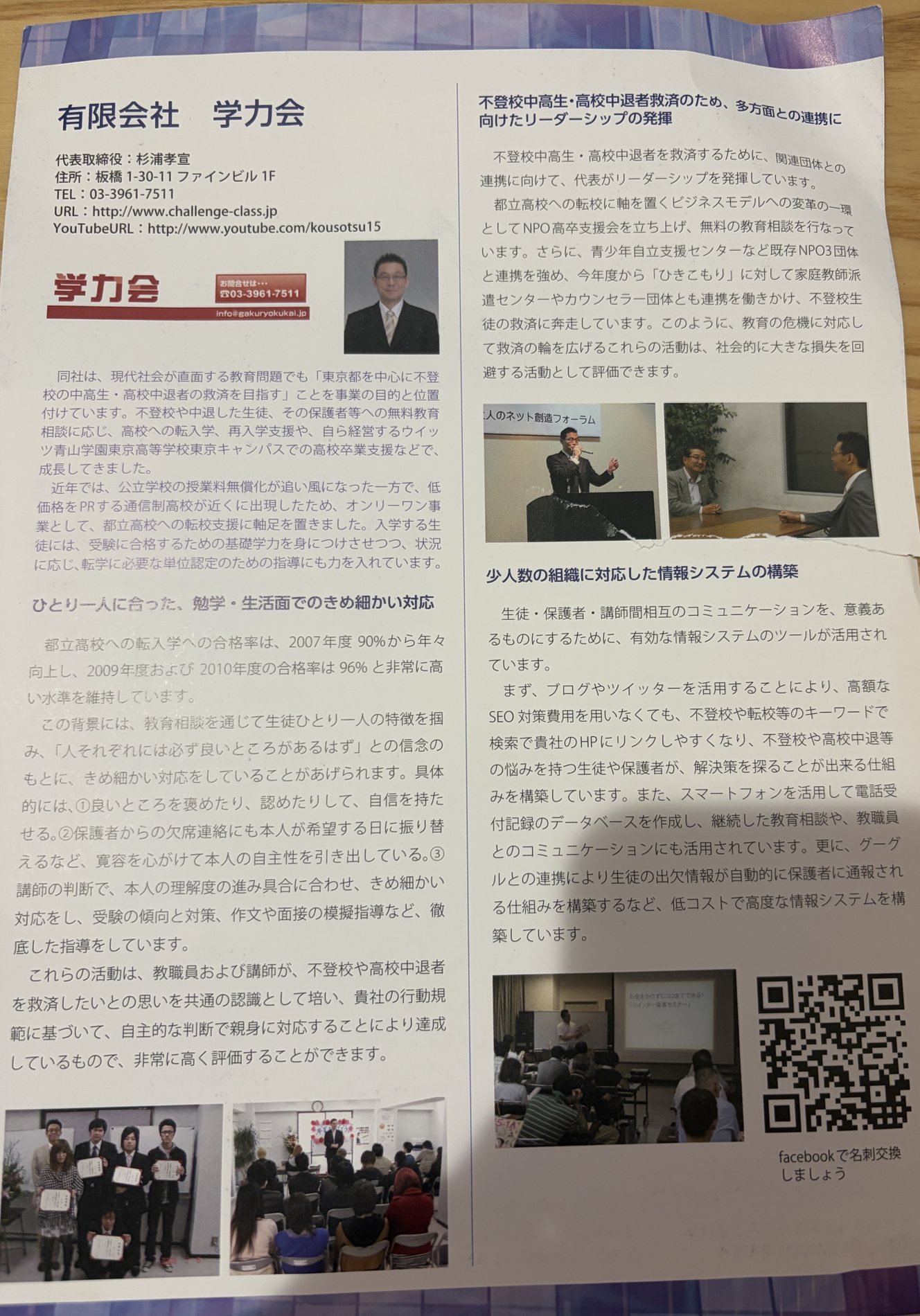
- Transfer acceptance rate: 90% in 2007
- 96% in 2009 and 2010
- Launch of the NPO High School Support Association
- Award14th Itabashi Management Quality Award (FY2010)
Special Award — Gakuryokukai Co., Ltd. - Acceptance rates90% in 2007 · 96% in 2009
96% in 2010 - SelectivityGrand award not given
in 8 of 14 years
02During the Gakuryokukai Period, Resolution Meant Successful School Transfer
During the period of Gakuryokukai Co., Ltd., one of the main groups supported consisted of students who had experienced school refusal or dropped out of high school and wanted to resume their education at another high school. Particular emphasis was placed on transfer support to Tokyo metropolitan high schools, including Shinjuku Yamabuki High School.
The outcome measure was therefore clear:
- School refusal or dropout
- Transfer support to a Tokyo metropolitan high school
- Successful transfer examination
This was an objectively verifiable educational result. Official materials from the Itabashi Management Quality Award recorded the following acceptance rates:
Source: Official booklet of the 14th Itabashi Management Quality Award, fiscal year 2010 — page on Gakuryokukai Co., Ltd.
At that stage, resolution was measured primarily through successful transfer into another high school.
03Outcomes Were Recorded, Measured, and Disclosed Publicly
Gakuryokukai did not end its involvement when support was provided. Results were followed. Records were maintained concerning the student’s history of school refusal or dropout, the schools they applied to, and the educational destinations they subsequently entered.
The operating principle was:
- Practice
- Confirm outcomes
- Record results
- Measure them
- Disclose them externally
This approach formed an important part of the evidence culture that later developed into JADA.
04External Review Through the Itabashi Management Quality Award
In fiscal year 2010, Gakuryokukai Co., Ltd., led by Takanobu Sugiura, received the Special Award of the 14th Itabashi Management Quality Award.
The recipient was Gakuryokukai, not JADA. This award belongs to the earlier history of the practice from which JADA’s current framework later developed.
The award used an assessment approach modeled on the Japan Quality Award. Applicants were assessed on an absolute 1,000-point scale based on the Japan Quality Award assessment criteria, and only organizations that exceeded a set standard were recognized. The assessment examined areas including:
- Understanding and responding to customers and markets
- Leadership
- Social responsibility
- Strategy development and deployment
- Development of people and organizational capability
- Customer-value creation processes
- Information management
- Organizational results
According to the list of past recipients printed in the official booklet, the highest award was not given in 8 of the 14 years from the 1st to the 14th award. The program therefore did not automatically recognize applicants.
05Five to Six Assessors Visited Gakuryokukai
During the assessment process, approximately five to six assessors visited the Gakuryokukai classrooms. They examined client records, histories of school refusal and high school dropout, and the educational destinations of the students after support.
The review went beyond company descriptions or self-reported figures. It examined actual support records and subsequent outcomes.
The detailed assessment report is no longer available. However, the following remain as evidence that an external review took place:
- The official award booklet (fiscal year 2010)
- The record of Gakuryokukai in the booklet
- The record of the Special Award
- The documented transfer outcomes
CHAPTER 2
NPO, Press, Publication and Media
Results were not kept internal. They were opened to the press, publishers and society.
06NPO High School Support Association Was Operating at the Same Time
While operating Gakuryokukai Co., Ltd., Takanobu Sugiura was also developing the NPO High School Support Association. The purpose was broader than school transfer alone. The activity expanded to support:
- School refusal
- High school dropout
- Educational re-engagement
- High school completion
- Further education
- Social participation
The practical knowledge accumulated through Gakuryokukai was carried forward into the nonprofit work.
07Support Outcomes Were Presented at a Press Conference
Results from support for transfers into Tokyo metropolitan high schools were publicly presented at a press conference. Participants included representatives from:
- NHK
- Asahi Shimbun
- Yomiuri Shimbun
- Nikkei
- Mainichi Shimbun
- Tokyo Shimbun
- Takarajimasha
Takanobu Sugiura explained the option of transferring to Tokyo metropolitan high schools, including Shinjuku Yamabuki High School, for young people affected by school refusal or high school dropout. He also presented support outcomes, acceptance rates, and the practical approach used.
If results exist, record them, measure them, and make them open to external scrutiny.

08Publication by Takarajimasha
The accumulated experience and support records were also shared with publishers. This later led to the publication by Takarajimasha of “Koko Chutai Futoko demo Hikikomori demo Yarinaoseru”.
The book presented the idea that young people affected by school refusal, dropout, or hikikomori can restart their lives when their environment is adjusted and appropriate support is provided.
Publication was not treated as proof by itself. Rather, it provided another opportunity for accumulated practice and documented experience to be examined and communicated publicly.
09National Media Coverage, Including NHK
Takanobu Sugiura and the support activities developed through his organizations were subsequently covered by national and other media, including NHK’s Ohayo Nippon. Coverage included not only philosophy but also elements of actual support practice, family involvement, educational pathways, and social participation.
JADA does not treat media coverage itself as proof of support effectiveness. However, independent reporting forms part of the broader public record showing that the work was opened to outside examination.
CHAPTER 3
Becoming a Certified NPO
Meeting the standards of public benefit, governance and disclosure, and building public accountability.
10The High School Support Association Later Became a Certified NPO
The High School Support Association continued and expanded the practice developed through Gakuryokukai. It later became a Certified NPO Corporation in Japan.
Certified NPO status requires additional standards related to public benefit, organizational operation, governance, and disclosure beyond ordinary NPO incorporation. Only around 3% of NPO corporations in Japan hold Certified NPO status.According to the Cabinet Office NPO portal, 1,311 of Japan’s 48,754 incorporated NPOs (about 2.7%) held Certified or Special Certified NPO status (figures as of October 27 and August 31, 2026). (Source: Cabinet Office NPO portal)
This adds another layer of public accountability to the history of the practice.
- Long-term practice
- Measured outcomes
- Public disclosure
- External review
- NPO activity
- Press conference
- Publication
- National media coverage
- Certified NPO
CHAPTER 4
JADA Today
Support extended to prolonged hikikomori, and four decades of practice organized into a coherent framework.
01The Meaning of “Resolution” Has Evolved with the Scope of Support
To understand JADA’s 90%+ resolution record, it is important to distinguish between the historical outcome measure used during the Gakuryokukai period and the broader definition used by JADA today.
The historical school-transfer success rate and JADA’s present definition of resolution are not identical measures. Each reflects the population being supported and the practical objective of that period.
11JADA’s Current Definition of Resolution
Today, JADA supports not only school refusal and high school dropout but also prolonged social withdrawal and hikikomori. For this population, returning to a conventional school cannot be the only meaningful measure of resolution. JADA therefore defines an important point of resolution as:
The point at which the young person, through their own decision, takes a concrete step toward learning again or reconnecting with society.
This may include:
Re-engagement with Learning
- Returning to their previous school
- Attending a free school or alternative educational setting
- Enrolling in a correspondence high school or support school
- Attending a preparatory school
- Preparing for a high school equivalency qualification
- Preparing for university entrance examinations
- Progressing to university or vocational education
Re-engagement with Society
- Beginning part-time work
- Participating in work experience
- Undertaking an internship
- Volunteering
- Entering employment
- Establishing another sustained form of social participation
The central factor is agency. JADA does not define resolution simply as compliance with instructions from parents or professionals. The young person begins to make a decision and act for themselves.
12Resolution Is Not the Final Goal
For JADA, resolving school refusal or hikikomori is not the end of the support process. Resolution means the point at which a young person begins moving forward again through their own decision. The longer pathway may continue through:
- Re-engagement with learning
- Human connection
- Social participation
- Work
- Independent daily life
- Contribution to society
The ultimate goal is Social Autonomy: developing the capacity to learn, work, participate in society, and build one’s own life with increasing independence and responsibility.
13JADA Now Systematizes More Than 40 Years of Practice
Autonomy Stage OS
Autonomy Stage OS is JADA’s core framework for understanding the current position of a young person and family and determining what kind of support may be required. The 5-Stage Assessment sits within Autonomy Stage OS as an assessment framework. It is not a medical or psychiatric diagnosis.
JADA Support Philosophy
At the center of JADA’s approach is Parent Coaching × Direct Support for the Young Person. JADA does not assume that changing parents alone will resolve the situation. Nor does it assume that supporting the young person alone is sufficient. Both sides are addressed.
7 Steps to Autonomy
- 1Parent Coaching & Stage Assessment
- 2Outreach / Home Visits
- 3Daily-Life and Environmental Restructuring
- 4Re-engagement with Learning
- 5Rebuilding Social Connections
- 6Education, Employment and Social Participation
- 7Social Autonomy
14JADA Success Hub / Evidence
JADA does not treat success stories simply as testimonials. Where possible, each case documents:
- Situation before support
- Family circumstances
- Parent coaching
- Direct support
- Turning points
- Re-engagement
- Further education or employment
- Current status
These records are accumulated through the JADA Success Hub / Evidence and are used to improve practice and support future research.
Historical and Current Definitions of Resolution
Gakuryokukai Period
- School refusal / high school dropout
- Transfer support into Tokyo metropolitan high schools
- Successful transfer examination
- Measured as a transfer success rate
Outcomes were measured mainly through clear, objective educational results.
JADA Today
- School refusal / hikikomori
- Restoring daily life and the family environment
- The young person begins making their own decisions
- Re-engagement with learning or social participation
- Resolution / Restart
- Continued learning, work and participation
- Social Autonomy
The supported population and social circumstances have changed over more than four decades.
The principle that has remained consistent for over 40 yearsHelping a young person move from prolonged stagnation toward self-directed action and participation in life.
FAQFrequently Asked Questions
QDoes JADA’s 90%+ resolution record mean a 90% school-return rate?
No. During the Gakuryokukai period, outcomes were measured mainly through successful transfers into Tokyo metropolitan high schools. Today, JADA defines resolution more broadly as the point at which a young person voluntarily takes a concrete step toward learning or social participation.
QAre the historical 90–96% transfer rates and JADA’s current 90%+ resolution record the same measure?
No. They are different measures used for different support populations. Historical figures referred mainly to school-transfer outcomes. JADA’s current definition includes voluntary educational re-engagement, part-time work, work experience, employment, and other forms of social participation.
QHow was Gakuryokukai externally reviewed?
Approximately five to six assessors visited Gakuryokukai’s classrooms and examined client records, school refusal and dropout histories, and subsequent educational destinations. Gakuryokukai later received the Special Award of the 14th Itabashi Management Quality Award.
QDid JADA receive the Itabashi Management Quality Award?
No. The recipient was Gakuryokukai Co., Ltd., led by Takanobu Sugiura. The award belongs to the earlier history of the practice from which JADA later developed its current framework.
QIs there a record of the press conference?
Yes. A video remains available showing the press conference attended by representatives from NHK, Asahi, Yomiuri, Nikkei, Mainichi, Tokyo Shimbun and Takarajimasha (watch on YouTube).
QWhat is JADA’s final goal?
The final goal is not simply a return to school. It is Social Autonomy: the ability to learn, work, participate in society, and build one’s own life with increasing independence and responsibility.
Related Pages
Built from practice, not just theory.
A support framework developed through more than 40 years of direct work.
JADA makes the practice and outcomes accumulated over more than 40 years open to society, and contributes to a future that supports the Social Autonomy of children and young people.