By Takanobu Sugiura — Representative Director, Japan Autonomous Development Association (JADA); Founder, Kousotsu Shien Kai
Article prepared: 20 November 2026 · Hong Kong proposal status checked against the original Japanese article dated 19 November 2026.
From Japanese Field Practice to International Practitioner Training
How can more than four decades of field experience supporting young people experiencing school refusal, school dropout and hikikomori be passed on to future practitioners? This question connects JADA’s lectures in Japan with emerging international dialogue.
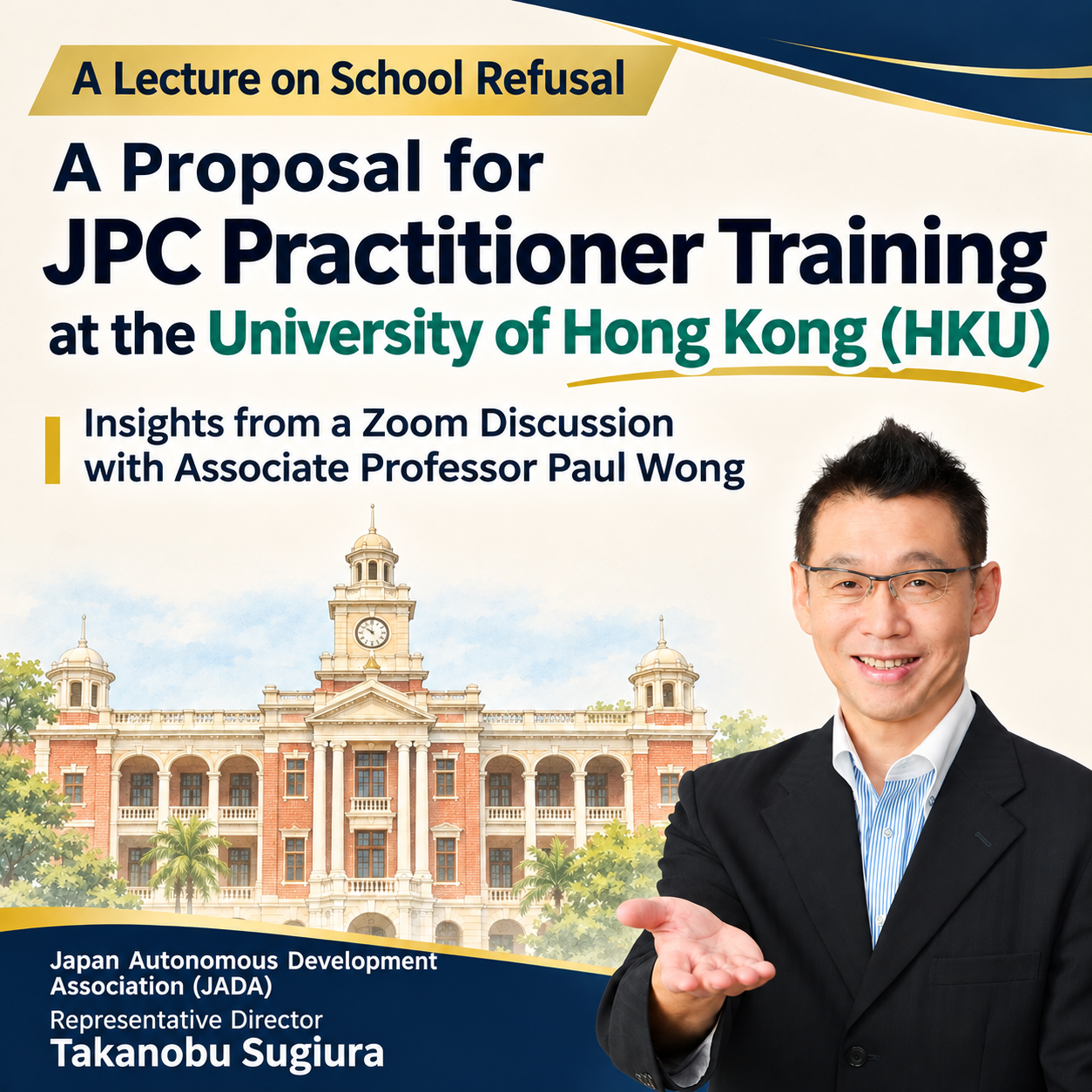
On 16 November 2026, Takanobu Sugiura and JADA colleagues met online with Associate Professor Paul Wai-Ching Wong of the University of Hong Kong (HKU). The following day, JADA sent a proposal combining introductory JPC practitioner training with potential supervised internships in Japan. No university training programme or research partnership had been confirmed as of the original article’s 19 November status date.
JADA’s long-term objective goes beyond returning a child to school: it is Social Autonomy, including sustainable participation in education, work and wider society.
Key Facts
- Practice: more than 40 years; more than 10,000 young people and families supported
- Waseda University: symposium on school dropout and career guidance, 13 December 2014
- Imabari: lecture at Imabari Meitoku Junior College, 18 May 2024, following educational exchanges connected to Takeshi Okada
- HKU discussion: 16 November 2026 with Associate Professor Paul Wong
- JPC proposal: submitted 17 November 2026, pending further discussion
What a School Refusal Lecture Should Help Families Understand
School refusal in Japan, often called futoko, may affect daily routines, family communication, educational continuity and social relationships. JADA therefore encourages families to look beyond attendance alone: How is the young person living now? Who is supporting them directly? What pathway could reconnect them with learning, community and future employment?
JADA combines Parent Coaching × Direct Support for the Young Person. Parents may need guidance on communication and consistent home expectations, while young people may need outreach, trusted relationships, accompanied outings and practical support.
Waseda University: Preventing School Dropout and Preserving Educational Pathways
On 13 December 2014, Sugiura spoke at Waseda University on preventing upper-secondary school dropout and protecting access to continued education. The university’s subsequent report described nearly 100 participants, including practising teachers and education professionals.
His field examples included the Tokyo metropolitan public high-school transfer and re-entry system. For an international audience, these are institutional routes through which eligible students may continue or resume upper-secondary education; a change of school does not by itself guarantee sustained participation.
Related JADAGlobal Video: Correspondence High Schools in Japan: Beyond Graduation to Social Autonomy
What this video shows: This English-language video discusses correspondence-based upper-secondary education and why graduation should be connected to longer-term social participation.
Why this matters: It complements the Waseda symposium’s attention to alternatives for students at risk of leaving education.
Imabari: School Refusal and Education for Autonomy
Discussions with Takeshi Okada, a former manager of Japan’s national football team and a leader associated with FC Imabari, contributed to educational exchange in Ehime Prefecture. On 18 May 2024, Sugiura delivered a lecture at Imabari Meitoku Junior College on school refusal and hikikomori.
The key question was how adults can help young people rebuild daily life, make decisions and act independently. JADA sees those steps as foundations for later education, work and social participation.
Related JADAGlobal Video: Mission, Passion, Action: Takanobu Sugiura’s Message to Graduates
What this video shows: Takanobu Sugiura addresses graduates about mission, motivation and action.
Why this matters: The message connects educational progress with the wider aim of Social Autonomy, the central theme of the Imabari lecture.
Original lecture record: Imabari lecture in Japanese (Japanese-language primary record, linked rather than replacing the English-language JADAGlobal video).
University of Hong Kong: Comparing Outreach Approaches
In the 16 November 2026 discussion, Professor Wong and JADA explored different ways of making initial contact with socially withdrawn young people. The Japanese article describes Hong Kong experience involving dogs in home visits, while JADA described using familiar interests such as video games and esports to establish trust.
JADA may also introduce a peer of a similar age or a slightly older young person to support the transition from home to a free school or other community setting. These approaches present possibilities for comparison, not evidence that any single technique is universally effective.
Related JADAGlobal Video: Hikikomori Today: A Support Worker’s Lived Experience of Social Withdrawal
What this video shows: A JADA support worker reflects on lived experience of social withdrawal and the importance of meaningful relationships.
Why this matters: It gives international researchers an additional practitioner perspective on the outreach and relationship-building discussed with Professor Wong.
Proposed JPC Training and Supervised Field Experience
On 17 November 2026, JADA proposed two possible elements for students and prospective practitioners: introductory JPC instruction online or in Hong Kong, and optional supervised experience at support settings in Japan. Potential subjects include parent coaching, JADA’s 5-Stage Assessment, relationship-building, anonymised case review and role-play.
JADA stated that consent, confidentiality and appropriate supervision would be necessary. Programme dates, cohort size, implementation arrangements and qualifications or certification have not been confirmed.
Autonomy Stage OS and the 7 Steps to Autonomy
The Autonomy Stage OS is JADA’s overall framework. Its 5-Stage Assessment is an assessment framework for understanding the current situation of a young person and family; it is not a medical diagnosis.
JADA’s support philosophy is Parent Coaching × Direct Support for the Young Person. Its practical process is organised as the 7 Steps to Autonomy:
- Parent Coaching & Stage Assessment
- Outreach / Home Visits
- Lifestyle Stabilisation & Environmental Adjustment
- Re-engagement with Learning
- Rebuilding Social Connections
- Education, Employment & Social Participation
- Social Autonomy
Practice-Based Evidence: Recovery and Social Participation
JADA’s Success Hub documents case histories as practice-based evidence, with clear limits on generalisation. In CASE14, a young man known as N experienced approximately two years of hikikomori. The Japanese source reports 69 home visits over about seven months, followed by entry into correspondence-based upper-secondary education, five-day attendance, part-time work, study in Canada and university enrolment in April 2025.
This is one documented pathway; neither the number of visits nor the outcomes should be treated as an expected result for every family.
Related JADAGlobal Video: My Tiny Trigger to School Refusal… and the Outreach That Saved Me
What this video shows: A separate English-language personal account concerns school refusal and outreach. This is a related example, not CASE14.
Why this matters: It offers an additional perspective on engagement and change, while the written CASE14 account remains the primary source for N’s history.
Implications for Researchers and Practitioners
Future work might compare animal-assisted outreach, interest-based contact and peer support; document progression over the first 90 days; or examine how field cases can inform supervised training. Such comparisons require explicit research design, consent and defensible outcome definitions. A preliminary dialogue is not a completed scientific trial.
About JADA’s Evidence Base
JADA draws on more than four decades of practice and reports supporting over 10,000 young people and families. Its stated resolution rate of over 90% is an organisation-reported outcome; definitions and supporting records should be reviewed via its Success Hub and Japanese official website. These practice reports are not equivalent to an independently controlled study.
Frequently Asked Questions
What is JADA’s approach to school refusal?
JADA considers the young person’s daily life and social connections as well as education, and combines parent coaching with practical support for the young person.
Can parents consult JADA before their child leaves home?
Yes. Parents may begin by describing current routines, communication and circumstances. JADA can then consider next steps and whether outreach is appropriate.
Is the 5-Stage Assessment a clinical diagnosis?
No. It is an assessment framework within the Autonomy Stage OS, not a medical or clinical diagnosis.
How can home visits support a young person experiencing hikikomori?
Outreach can create a starting point for trust, using interests and consistent contact to identify suitable opportunities for wider participation.
Has HKU approved a JADA training programme?
Not as of the status reported in the Japanese source on 19 November 2026. JADA had submitted a proposal on 17 November, with arrangements still to be discussed.
Can JADA speak at overseas education or social-work events?
JADA welcomes enquiries and discusses the topic, language arrangements, delivery format and costs individually.
Lectures, Training and International Enquiries
Universities, educators, social-work researchers, community organisations and media can contact JADA regarding lectures, practitioner education and comparative dialogue.
Contact JADA · English official website · JADAGlobal videos
References
- Original Japanese article (19 November 2026)
- Waseda University symposium report
- HKU: Paul Wong faculty profile
- JADA Success Hub
Editorial note: Embedded English-language videos illustrate their respective topics. The precise video upload dates and the final video’s channel ownership have not been independently verified; the schema below intentionally does not state dates or unverified channel attribution. Confirm these before publication if rich video indexing is required.