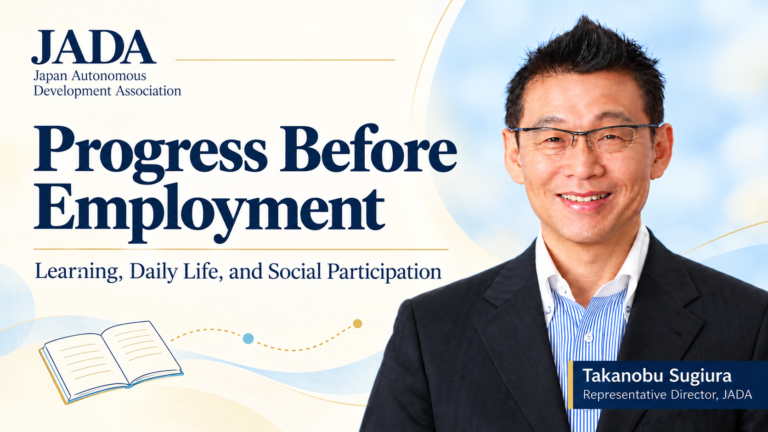

Practice from Japan: connecting education, work, and social participation.
By Takanobu Sugiura, Founder and Representative Director of the Japan Autonomous Development Association (JADA), and Founder and Chair of Kousotsu Shienkai.
A young person who leaves school should not have to choose between continuing their education and gaining experience at work. My work with Yoronotaki, a Japanese restaurant group, grew from that conviction. We brought learning into a business setting and connected it with opportunities for part-time employment.
The idea was practical: a place to study during the day, and a place to work later. The aim was not simply to secure a room or tell a young person to find a job. It was to create opportunities to learn, meet people, take responsibility, and contribute.
This initiative was reported by Nikkei Shimbun (日本経済新聞) and NHK. Nikkei featured it in its evening edition on June 27, 2015, and NHK covered the use of available space for children’s learning on June 9, 2016. Read about the newspaper and television coverage.
This article revisits an earlier Kousotsu Shienkai initiative documented in 2015–2016. I explain the proposal and direct interview from my own recollection, distinguish those details from published activity records, and show how the practice relates to what JADA now calls STEP 6: Career & Social Participation within the 7 Steps to Autonomy. It is a historical account, not an announcement of current classes or vacancies at Yoronotaki. Sources and scope of this account
Why I approached a restaurant company
For young people who had experienced school refusal, high school dropout, or social withdrawal, a classroom alone was not always enough. In my practice, I wanted to connect learning with opportunities to interact with people outside the family and school.
Through an introduction, I met Yoronotaki’s president at the time, Toshiyuki Yamada (矢満田敏之). I remember the meeting lasting about ten minutes. The substance of my proposal was simple: could space that was available during the day become a place for young people to study, with opportunities for part-time work later?
Learning during the day. Work experience in the evening. I was asking for cooperation that connected education with participation in society, rather than a room loan alone. The proposal and the approximate meeting length are my recollection; they are not a transcript of a recorded meeting. [Author’s account]
In my article first published on January 21, 2016, I recorded that Kousotsu Shienkai was using space on the third floor of Yoronotaki’s headquarters for classes. The article described a young person studying toward high school graduation while working part-time at Yoronotaki. [1]
The president personally interviewed the student
Creating an opportunity required more than encouraging a student to apply. I introduced a student to Yoronotaki’s president, who personally interviewed him. This is the account I have clarified when revisiting the initiative. [Author’s account]
The point is not that every employer partnership needs a president to conduct interviews. It is that a support practitioner can work on both sides of the relationship: helping a young person prepare, while speaking directly with an employer about an opportunity to participate.
Instead of asking only, “Is this young person ready for society?”, I also asked what we could do to make a real encounter with society possible.
What the activity records show
An eighteen-year-old combining study and work
The January 2016 article described an eighteen-year-old attending our learning setting while working toward high school graduation and holding a part-time job at Yoronotaki. When I asked about the work, he described the staff as kind and the workplace as comfortable. [1]
That exchange mattered to me. It showed how he experienced the workplace at that moment: not just as a source of income, but as a setting where he felt welcomed. It does not establish that the work was easy, or that the same setting would suit every young person.
A separate account of learning and three shifts a week
Another Kousotsu Shienkai article records a seventeen-year-old who had experienced school refusal and withdrawal. He was attending the Yoronotaki classroom, revisiting earlier schoolwork, and preparing for further education. The article also records that he began working three times a week. [2]
I do not assume that the seventeen-year-old in that account and the eighteen-year-old in the January 2016 article are the same person. The records support the more modest point that learning opportunities and actual part-time work were connected in this initiative.
Reported by Nikkei Shimbun and NHK
The Yoronotaki initiative was covered in both a newspaper report and a television news segment. These reports concerned the practical use of business space as a place where young people could resume learning. The coverage dates and details below follow Kousotsu Shienkai’s published media archive. [3]
Nikkei Shimbun — June 27, 2015
Nikkei Shimbun (日本経済新聞) featured the initiative in its evening edition on , page 8. The archive records the Japanese title 「居酒屋学舎」, describing the restaurant-based learning initiative.
NHK’s Ohayō Nippon — June 9, 2016
NHK reported on the initiative in the Tokyo metropolitan segment of Ohayō Nippon on . The archive lists the segment as 「セーフティネットは今 空きスペースを子どもの学びの場に」, about using available space as a place for children’s learning.
For companies and educators, the practical question remains relevant: how can space, people, and work opportunities already present in a community be connected with a young person’s learning and participation? My purpose in revisiting this initiative is to share that practice, not simply to list media appearances.
The archive documents reporting on the initiative at the time. Media coverage is not an independent evaluation or an endorsement of every element of JADA’s later support framework.
Work as a setting for learning—not a replacement for education
I wanted young people to experience everyday responsibilities: greeting colleagues, listening to instructions, asking when they did not understand, arriving on time, and carrying out a task. Being paid for work also connects an activity with a real contribution.
These are the kinds of experiences I have sought to support. They are not a measured list of outcomes achieved by every participant in the Yoronotaki initiative.
Learning remained important. The opportunity to work was not a reason to abandon a high school qualification. Equally, a young person did not have to postpone every experience of work until graduation. Education and suitable employment could be considered together.
This does not mean that restaurant work—or customer-facing work—is right for everyone. The young person’s wishes, health, responsibilities, learning commitments, and available support must guide the choice.
A precedent for STEP 6, not a framework imposed on the past
Built from Practice, Not Just Theory. The Yoronotaki initiative was one of the earlier experiences that informed the approach I later organized through JADA. We were not using today’s “Autonomy Stage OS” or “7 Steps to Autonomy” names at the time.
Viewed through the current framework, the initiative connects learning support, social contact, and especially STEP 6: Career & Social Participation. JADA’s English overview also describes this step as Pathway & Social Participation Support. The historical activity is a practical precedent—not evidence that every participant completed all seven steps.
Autonomy Stage OS is the central framework. Its 5-Stage Assessment helps clarify the young person’s and family’s current situation and support needs; it is not a medical diagnosis. The 7 Steps to Autonomy organize the practical support process.
The guiding philosophy is Parent Coaching × Direct Support for the Young Person. Employers do not replace families or support practitioners. A workplace opportunity needs to be connected with the support the individual actually requires.
The roles of Kousotsu Shienkai and JADA
The historical classroom and employment initiative described here belonged to the work of Kousotsu Shienkai (高卒支援会), the Japanese nonprofit I founded. It supports young people through learning settings and practical assistance.
JADA now organizes and shares the wider practice-based framework, combining family assessment, parent coaching, support planning, and direct support. The organizations are not interchangeable, and the historical partnership should not be attributed retroactively to JADA’s current brand.
Support also depends on the people who help turn opportunities into action. Seiya Okura was a staff member during the Yoronotaki period and later supported young people with applications and interviews. His present JPC designation is not a title we apply retrospectively to that period. Nobue Sugiura’s present work also connects daily-life support with practical steps such as looking for part-time work and preparing applications. [Team records]
Two related journeys—not Yoronotaki employment cases
The Japanese remake includes the following two videos. They illustrate related ways of connecting learning, experience, and employment. Neither young person is identified here as the student who worked at Yoronotaki.
Sakou: education, part-time work, and interview preparation
Sakou experienced school refusal, moved to a correspondence high school, and later entered university. He continued part-time work and received interview support from Okura. The video is introduced as a record of the journey toward a corporate job offer; the separate Japanese case article describes subsequent employment. An offer, starting work, and sustained employment are different milestones. Read Sakou’s Japanese case article.
- Original Japanese title
- 【不登校から超一流企業へ】進学校での挫折・引きこもりを乗り越え内定を勝ち取った「自律」の軌跡
- Publication date in JADA’s archived video record
- Language
- Japanese. The English text here is an editorial summary, not a transcript.
- Channel
- JADA’s official Japanese-language YouTube channel
- Watch
- Watch this video on YouTube
- Related case record
- Read the Japanese case record
S.: rebuilding contact before entering employment
After leaving high school, S. spent about sixteen months in social withdrawal. His support did not begin with an immediate demand to find work. Renewed outings and social contact came first. The Japanese record describes setbacks, including difficulty sustaining part-time work, followed by agricultural experience, agricultural college, and employment with a Japan Agricultural Cooperative, or JA.
The Japanese follow-up record updated on October 5, 2026 reports two years of continued employment. That follow-up is separate from the video’s account of the path into employment; the period should not be extended simply because more time has passed. Read S.’s Japanese case article.
- Original Japanese title
- 【決定版】不登校・16ヶ月引きこもりからJA(農協)就職へ|憲法26条とSDGs4が示す「自律支援」の正解【JADA公式】
- Publication date in JADA’s archived video record
- Language
- Japanese. The English text here is an editorial summary, not a transcript.
- Channel
- JADA’s official Japanese-language YouTube channel
- Watch
- Watch this video on YouTube
- Related case record
- Read the Japanese case record
Video titles and publication dates above follow JADA’s archived Japanese records. The English introductions summarize those records; they do not claim to reproduce every statement in the videos or to establish that English subtitles are available.
Practical questions for employers, educators, and parents
The following are present-day planning suggestions drawn from the account—not a claim that each procedure was formally documented in the historical initiative.
1. Must a business promise a job before it can help?
No. The Yoronotaki example connected a learning space with work opportunities, but it is not a demand that every partner hire. A visit, an introduction, or access to a suitable space can be a starting point. The offer must be clear, and it must not be presented to a family as guaranteed employment.
Next action for an employer: Write down one opportunity you can genuinely offer, the person responsible, and the support organization that would help prepare the young person.
2. Should someone who has left school work first and study later?
Not automatically. The original article described study toward high school graduation alongside part-time work. The appropriate balance depends on the individual’s goals, current routine, and capacity to sustain both activities.
Next action for a parent or educator: With the young person’s agreement, put remaining education requirements and the demands of one possible job side by side. Identify what would need support rather than deciding the entire pathway for them.
3. What needs to be agreed before work starts?
Do not judge a role by its pay or availability alone. Clarify the duties, hours, travel, person providing instruction, and contact for difficulties. Check current local employment and safeguarding requirements, particularly where minors are involved. This historical article is not legal advice or a confirmation of any present-day employment arrangement.
Next action for the support team: Prepare a one-page plan showing who supports learning, who supervises work, how the young person can raise concerns, and when the arrangement will be reviewed.
4. What can a parent do when the young person cannot apply?
First distinguish the difficulty: choosing a role, completing an application, contacting an employer, attending an interview, or leaving home. Giving more job listings may not address the actual obstacle. Parent coaching and direct support can help decide the next step without applying secretly on the young person’s behalf.
Next action for a parent: Ask which part feels hardest, when a conversation is possible. Share that specific difficulty with a support practitioner and agree on one action the young person can participate in.
5. Does leaving a part-time job erase previous progress?
No. S.’s separate record includes attempts that did not last. A setback should prompt a review of workload, health, relationships, and the fit between the person and the role—not a judgment that the young person has no future.
Next action for a parent or practitioner: Ask what was manageable, what was difficult, and what should change before another attempt. Do not repeat the same arrangement without understanding the problem.
6. Does a job offer mean Social Autonomy has been achieved?
A job offer is an important milestone, not the whole outcome. JADA looks toward the person sustaining daily life, relationships, learning or work, and increasing their ability to make decisions and seek help when needed.
Next action for the family and employer: Agree with the young person who they can contact when difficulties arise and how progress will be reviewed, without turning support into constant supervision.
Create opportunities in society—not just expectations of young people
The lesson I draw from Yoronotaki is not that every restaurant should become a school. It is that support can include changing what society makes available, rather than asking the young person to make every change alone.
In this example, a company provided a setting where learning and work could meet. I approached the company and helped create an interview opportunity. Young people then needed concrete support to take part.
For JADA, the longer-term goal is Social Autonomy: making choices, acting on them, maintaining relationships, and contributing through education, work, and participation in society. Learning, work, taxation, and social contribution are connected aspirations in our mission—not measures of a person’s worth or a requirement to manage without help.
These earlier practices are part of the history behind that goal. They are practice-based evidence to examine and learn from, not a universal formula or a guarantee of the same outcome.
Explore the JADA Success Hub, read the English introduction to 22 school-refusal and hikikomori recovery stories, or learn more about the founder’s practice and framework.
For companies, schools, and support organizations
JADA welcomes dialogue about education, employer partnerships, support practice, and international knowledge exchange. To discuss this example, contact JADA with your country, organization, and the question or opportunity you would like to explore. This invitation does not imply an existing partnership, available vacancy, or placement guarantee.
You can also visit JADA Global on YouTube.
Sources and scope of this account
This article adapts Japanese activity records and my account of the Yoronotaki initiative for an international audience. Historical observations, later recollections, and present-day planning suggestions are distinguished throughout.
- Takanobu Sugiura, “高校中退 就職”, first published January 21, 2016. Source for the third-floor classroom and the eighteen-year-old combining study with part-time work.
- Kousotsu Shienkai, “引きこもり,居酒屋でバイト” (Japanese). Used for its account of a seventeen-year-old’s learning and three work shifts a week. It is not used here to identify the interviewer, or to establish that this is the same student as in the 2016 article.
- Kousotsu Shienkai’s media-coverage archive (Japanese). Records the Nikkei Shimbun evening-edition feature of June 27, 2015 (page 8, 「居酒屋学舎」), and the NHK Ohayō Nippon Tokyo metropolitan segment of June 9, 2016 on using available space for children’s learning. The reporting details in this article are drawn from this archive; the newspaper report and broadcast are not reproduced here.
Related practice records: Seiya Okura and Nobue Sugiura (team profiles), and Sakou’s case and S.’s case (Japanese). The two video participants are separate from the historical Yoronotaki students.
Name reference: Yoronotaki’s company profile gives 矢満田敏之; the English spelling “Toshiyuki Yamada” follows his listing on the Japan Food and Beverage Association for Foreign Employment website. These references identify the person; they do not independently verify the meeting or student interview.